Letterman was born in Indianapolis, Indiana. His father, Harry Joseph Letterman (April 1915 – February 1973),[6] was a florist of British descent; his mother Dorothy Letterman (née Hofert, now Dorothy Mengering), a Presbyterian church secretary of German descent, is an occasional figure on the show, usually at holidays and birthdays.
Letterman lived on the north side of Indianapolis (Broad Ripple area), not far from Speedway, IN, and the Indianapolis Motor Speedway, and he enjoyed collecting model cars, including racers.[7] In 2000, he told an interviewer for Esquire that, while growing up, he admired his father's ability to tell jokes and be the life of the party. Harry Joseph Letterman survived a heart attack at age 36, when David was a young boy. The fear of losing his father was constantly with Letterman as he grew up.[8] The elder Letterman died of a second heart attack[9] at age 57.
Letterman attended his hometown's Broad Ripple High School at the same time as Marilyn Tucker Quayle (wife of the former Vice President) and worked as a stock boy at the local Atlas supermarket.[10] According to the Ball State Daily News, he originally had wanted to attend Indiana University, but his grades weren't good enough, so he decided to attend Ball State University, in Muncie, Indiana.[11] He is a member of the Sigma Chi Fraternity, and he graduated from what was then the Department of Radio and Television, in 1969. A self-described average student, Letterman endowed a scholarship for what he called "C students" at Ball State.[12]
Though he registered for the draft and passed his physical after graduating from college, he was not drafted for service in Vietnam due to receiving a draft lottery number of 352 (out of 365).[13]
Letterman began his broadcasting career as an announcer and newscaster at the college's student-run radio station—WBST—a 10-watt campus station which now is part of Indiana Public Radio.[14] He was fired for treating classical music with irreverence.[14]
Letterman then became involved with the founding of another campus station—WAGO-AM 570 (now WWHI, 91.3).[15]
Letterman credits Paul Dixon—host of the Paul Dixon Show, a Cincinnati-based talk show also shown in Indianapolis while Letterman was growing up—for inspiring his choice of career:[3]
In 1971, Letterman appeared as a pit road reporter for ABC Sports' tape-delayed coverage of the Indianapolis 500.[21] David is initially introduced as Chris Economaki in his job as a corner reporter. He interviews Mario Andretti who has just crashed out of the race and asks him a question about traffic on the course.
Letterman appeared in the summer of 1977 on the short-lived Starland Vocal Band Show.[24] He has since joked[when?] about how fortunate he was that nobody would ever see his performance on the program (due to its low ratings).
Letterman had a stint as a cast member on Mary Tyler Moore's variety show, Mary;[25] a guest appearance on Mork & Mindy (as a parody of EST leader Werner Erhard[26]); and appearances on game shows such as The $20,000 Pyramid,[27] The Gong Show, Password Plus[28] and Liar's Club. He also hosted a 1977 pilot for a game show entitled The Riddlers[29][30] that was never picked up.[citation needed] He was also screen tested for the lead role in Airplane!, a role that eventually went to Robert Hays.[31]
His dry, sarcastic humor caught the attention of scouts for The Tonight Show Starring Johnny Carson, and Letterman was soon a regular guest on the show. Letterman became a favorite of Carson's and was a regular guest host for the show beginning in 1978. Letterman credits Carson as the person who influenced his career the most.[2]

 Letterman at the 38th Primetime Emmy Awards in 1986
The show often featured quirky, genre-mocking regular features, including "Stupid Pet Tricks[38]", dropping various objects off the roof of a five-story building,[39] demonstrations of unorthodox clothing (such as suits made of Alka-Seltzer,[40] Velcro[41] and suet), a recurring Top 10 list, the Monkey-Cam[42] (and the Audience Cam), and a facetious letter-answering segment.[43] The Top 10 list, several "Film[s] by My Dog Bob" in which a camera was mounted on Letterman's own dog[44] (often with comic results), Stupid Human Tricks,[45] Small Town News,[46] and Stupid Pet Tricks[47] (which had its origins on Letterman's morning show) all eventually moved with Letterman to CBS.
Other memorable moments included Letterman using a bullhorn to interrupt a live interview on The Today Show, announcing that he was the NBC president while not wearing any pants; interrupting Al Roker on WNBC-TV's broadcast of Live at Five by walking into their studio (which occupied the same floor of 30 Rockefeller Plaza as Letterman's studio); and staging "elevator races", complete with commentary by NBC Sports' Bob Costas. In one infamous appearance, in 1982, Andy Kaufman (who was already wearing a neck brace) appeared to be slapped and knocked to the ground by professional wrestler Jerry Lawler (though Lawler and Kaufman's friend Bob Zmuda later revealed that the event was staged.)[48] In another memorable exchange, sex expert Dr. Ruth Westheimer included cucumbers in a list of handy sex objects that women could find at home. The following night, guest Ted Koppel asked Letterman "May I insert something here?" and Dave responded "OK, as long as it's not a cucumber."[citation needed]
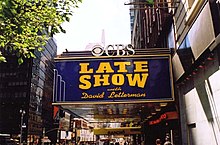
But while the expectation was that Letterman would retain his unique style and sense of humor with the move, Late Show was not an exact replica of his old NBC program. Recognizing the more formal mood (and wider audience) of his new time slot and studio, Letterman eschewed his trademark blazer with khaki pants and white sneakers wardrobe combination in favor of expensive shoes and tailored suits. The monologue was lengthened and Paul Shaffer and the "World's Most Dangerous Band" followed Letterman to CBS, but they added a brass section and were rebranded the "CBS Orchestra" as a short monologue and a small band were mandated by Carson while Letterman occupied the 12:30 slot. Additionally, because of intellectual property disagreements, Letterman was unable to import many of his Late Night segments verbatim[51], but he sidestepped this problem by simply renaming them (the "Top Ten List" became the "Late Show Top Ten", "Viewer Mail" became the "CBS Mailbag", etc.)
Following Leno's return to The Tonight Show, however, Leno has regained his lead.[58]
Letterman's shows have garnered both critical and industry praise, receiving 67 Emmy Award nominations, winning 12 times in his first 20 years in late night television. From 1993–2009, Letterman ranked higher than Leno in the annual Harris Poll of Nation's Favorite TV Personality 12 times.[59] For example, in 2003 and 2004 Letterman ranked second in that poll, behind only Oprah Winfrey, a year that Leno was ranked fifth.[60] Leno was higher than Letterman on that poll three times during the same period, in 1998, 2007, and 2008.[59]
Letterman recycled the apparent debacle into a long-running gag. On his first show after the Oscars, he joked, "Looking back, I had no idea that thing was being televised." He lampooned his stint two years later, during Billy Crystal's opening Oscar skit, which also parodied the plane-crashing scenes from that year's chief nominated film, The English Patient.
For years afterward, Letterman recounted his hosting the Oscars, although the Academy of Motion Picture Arts and Sciences continued to hold Letterman in high regard and they had invited him to host the Oscars again.[63][64] On September 7, 2010, he made an appearance on the premiere of the 14th season of The View, and confirmed that he had been considered for hosting again.
Letterman lived on the north side of Indianapolis (Broad Ripple area), not far from Speedway, IN, and the Indianapolis Motor Speedway, and he enjoyed collecting model cars, including racers.[7] In 2000, he told an interviewer for Esquire that, while growing up, he admired his father's ability to tell jokes and be the life of the party. Harry Joseph Letterman survived a heart attack at age 36, when David was a young boy. The fear of losing his father was constantly with Letterman as he grew up.[8] The elder Letterman died of a second heart attack[9] at age 57.
Letterman attended his hometown's Broad Ripple High School at the same time as Marilyn Tucker Quayle (wife of the former Vice President) and worked as a stock boy at the local Atlas supermarket.[10] According to the Ball State Daily News, he originally had wanted to attend Indiana University, but his grades weren't good enough, so he decided to attend Ball State University, in Muncie, Indiana.[11] He is a member of the Sigma Chi Fraternity, and he graduated from what was then the Department of Radio and Television, in 1969. A self-described average student, Letterman endowed a scholarship for what he called "C students" at Ball State.[12]
Though he registered for the draft and passed his physical after graduating from college, he was not drafted for service in Vietnam due to receiving a draft lottery number of 352 (out of 365).[13]
Letterman began his broadcasting career as an announcer and newscaster at the college's student-run radio station—WBST—a 10-watt campus station which now is part of Indiana Public Radio.[14] He was fired for treating classical music with irreverence.[14]
Letterman then became involved with the founding of another campus station—WAGO-AM 570 (now WWHI, 91.3).[15]
Letterman credits Paul Dixon—host of the Paul Dixon Show, a Cincinnati-based talk show also shown in Indianapolis while Letterman was growing up—for inspiring his choice of career:[3]
- "I was just out of college [in 1969], and I really didn't know what I wanted to do. And then all of a sudden I saw him doing it [on TV]. And I thought: That's really what I want to do!"
Weatherman
Letterman began his career as a radio talk show host on WNTS (AM), and on Indianapolis television station WLWI (now called WTHR) as a local anchor and weatherman. He received some attention for his unpredictable on-air behavior, which included congratulating a tropical storm for being upgraded to a hurricane and predicting hail stones "the size of canned hams."[16] He would also occasionally report the weather and the day's very high and low temps for fictitious cities ("Eight inches of snow in Bingree and surrounding areas.") while on another occasion saying that a state border had been erased.[17] ("From space you can see the border between Indiana and Ohio has been erased. I'm not in favor of this.") He also starred in a local kiddie show, made wisecracks as host of a late night TV show called "Freeze-Dried Movies" (he once acted out a scene from "Godzilla" using plastic dinosaurs),[18] and hosted a talk show that aired early on Saturday mornings called "Clover Power,"[19] in which he interviewed 4-H members about their projects.[20]In 1971, Letterman appeared as a pit road reporter for ABC Sports' tape-delayed coverage of the Indianapolis 500.[21] David is initially introduced as Chris Economaki in his job as a corner reporter. He interviews Mario Andretti who has just crashed out of the race and asks him a question about traffic on the course.
Move to Los Angeles
In 1975, encouraged by his then-wife Michelle and several of his Sigma Chi fraternity brothers, Letterman moved to Los Angeles, California, with hope of becoming a comedy writer.[22] He started off by writing material for comedian Jimmie Walker.[23] He also began performing stand-up comedy at The Comedy Store, a proving ground for unknown comics.Letterman appeared in the summer of 1977 on the short-lived Starland Vocal Band Show.[24] He has since joked[when?] about how fortunate he was that nobody would ever see his performance on the program (due to its low ratings).
Letterman had a stint as a cast member on Mary Tyler Moore's variety show, Mary;[25] a guest appearance on Mork & Mindy (as a parody of EST leader Werner Erhard[26]); and appearances on game shows such as The $20,000 Pyramid,[27] The Gong Show, Password Plus[28] and Liar's Club. He also hosted a 1977 pilot for a game show entitled The Riddlers[29][30] that was never picked up.[citation needed] He was also screen tested for the lead role in Airplane!, a role that eventually went to Robert Hays.[31]
His dry, sarcastic humor caught the attention of scouts for The Tonight Show Starring Johnny Carson, and Letterman was soon a regular guest on the show. Letterman became a favorite of Carson's and was a regular guest host for the show beginning in 1978. Letterman credits Carson as the person who influenced his career the most.[2]
NBC

Morning show
Main article: The David Letterman Show
On June 23, 1980, Letterman was given his own morning comedy show on NBC, The David Letterman Show. It was originally 90 minutes long, but was shortened to 60 minutes in August 1980.[32] The show was a critical success, winning two Emmy Awards, but was a ratings disappointment and was canceled in October 1980.Late Night with David Letterman
Main article: Late Night with David Letterman
NBC kept Letterman under contract to try him in a different time slot. Late Night with David Letterman debuted February 1, 1982; the first guest on the first show was Bill Murray[33]. The show ran Monday through Thursday at 12:30 a.m. Eastern Time, immediately following The Tonight Show Starring Johnny Carson (a Friday night broadcast was added in June 1987. It was seen as being edgy and unpredictable, and soon developed a cult following (particularly among college students). Letterman's reputation as an acerbic interviewer was borne out in verbal sparring matches with Cher[34] (who even called him an asshole on the show), Shirley MacLaine[35], Charles Grodin, and Madonna. The show also featured comedy segments and running characters, in a style heavily influenced by the 1950s and '60s programs of Steve Allen.[36] Although Ernie Kovacs is often cited as an influence on the show,[37] Letterman has denied this.[2]The show often featured quirky, genre-mocking regular features, including "Stupid Pet Tricks[38]", dropping various objects off the roof of a five-story building,[39] demonstrations of unorthodox clothing (such as suits made of Alka-Seltzer,[40] Velcro[41] and suet), a recurring Top 10 list, the Monkey-Cam[42] (and the Audience Cam), and a facetious letter-answering segment.[43] The Top 10 list, several "Film[s] by My Dog Bob" in which a camera was mounted on Letterman's own dog[44] (often with comic results), Stupid Human Tricks,[45] Small Town News,[46] and Stupid Pet Tricks[47] (which had its origins on Letterman's morning show) all eventually moved with Letterman to CBS.
Other memorable moments included Letterman using a bullhorn to interrupt a live interview on The Today Show, announcing that he was the NBC president while not wearing any pants; interrupting Al Roker on WNBC-TV's broadcast of Live at Five by walking into their studio (which occupied the same floor of 30 Rockefeller Plaza as Letterman's studio); and staging "elevator races", complete with commentary by NBC Sports' Bob Costas. In one infamous appearance, in 1982, Andy Kaufman (who was already wearing a neck brace) appeared to be slapped and knocked to the ground by professional wrestler Jerry Lawler (though Lawler and Kaufman's friend Bob Zmuda later revealed that the event was staged.)[48] In another memorable exchange, sex expert Dr. Ruth Westheimer included cucumbers in a list of handy sex objects that women could find at home. The following night, guest Ted Koppel asked Letterman "May I insert something here?" and Dave responded "OK, as long as it's not a cucumber."[citation needed]
Late Show with David Letterman

Main article: Late Show with David Letterman
In 1992, Johnny Carson retired, and many fans believed that Letterman would become host of The Tonight Show. When NBC instead gave the job to Jay Leno, Letterman departed NBC to host his own late-night show on CBS, opposite The Tonight Show at 11:30 p.m., called the Late Show with David Letterman. The new show debuted on August 30, 1993 and was taped at the historic Ed Sullivan Theater, where Ed Sullivan taped his eponymous variety series from 1948 to 1971. For Letterman's arrival, CBS spent $8 million in renovations[49]. In addition to that cost, CBS also signed Letterman to a lucrative three-year, $14 million/year contract[50], doubling his Late Night salary. The total cost for everything (renovations, negotiation right paid to NBC, signing Letterman, announcer Bill Wendell, Shaffer, the writers and the band) was over $140 million.But while the expectation was that Letterman would retain his unique style and sense of humor with the move, Late Show was not an exact replica of his old NBC program. Recognizing the more formal mood (and wider audience) of his new time slot and studio, Letterman eschewed his trademark blazer with khaki pants and white sneakers wardrobe combination in favor of expensive shoes and tailored suits. The monologue was lengthened and Paul Shaffer and the "World's Most Dangerous Band" followed Letterman to CBS, but they added a brass section and were rebranded the "CBS Orchestra" as a short monologue and a small band were mandated by Carson while Letterman occupied the 12:30 slot. Additionally, because of intellectual property disagreements, Letterman was unable to import many of his Late Night segments verbatim[51], but he sidestepped this problem by simply renaming them (the "Top Ten List" became the "Late Show Top Ten", "Viewer Mail" became the "CBS Mailbag", etc.)
Popularity
The main competitor of The Late Show is NBC's The Tonight Show, which was hosted by Jay Leno for nearly 16 years, but from June 1, 2009, to January 22, 2010, was hosted by Conan O'Brien. In 1993 and 1994, The Late Show consistently gained higher ratings than Tonight. But in 1995, ratings dipped and Leno's show consistently beat Letterman's in the ratings; Leno typically attracted about 5 million nightly viewers between 1999 and 2009. The Late Show lost nearly half its audience during its competition with Leno, attracting 7.1 million viewers nightly in its 1993–94 season and about 3.8 million per night as of Leno's departure in 2009.[52] In the final months of his first stint as host of The Tonight Show, Leno beat Letterman in the ratings by a 1.3 million viewer margin (5.2 million to 3.9 million), and Nightline and The Late Show were virtually tied.[53] Once O'Brien took over Tonight, however, Letterman closed the gap in the ratings.[54][55][56] O'Brien initially drove the median age of Tonight Show viewers from 55 to 45, with most older viewers opting to watch The Late Show instead.[57]Following Leno's return to The Tonight Show, however, Leno has regained his lead.[58]
Letterman's shows have garnered both critical and industry praise, receiving 67 Emmy Award nominations, winning 12 times in his first 20 years in late night television. From 1993–2009, Letterman ranked higher than Leno in the annual Harris Poll of Nation's Favorite TV Personality 12 times.[59] For example, in 2003 and 2004 Letterman ranked second in that poll, behind only Oprah Winfrey, a year that Leno was ranked fifth.[60] Leno was higher than Letterman on that poll three times during the same period, in 1998, 2007, and 2008.[59]
Hosting the Academy Awards
On March 27, 1995, Letterman acted as the host for the 67th Academy Awards ceremony. Critics blasted[61] Letterman for what they deemed a poor hosting of the Oscars, noting that his irreverent style undermined the traditional importance and glamor of the event[citation needed]. In a joke about their unusual names (inspired by a similar joke by Woody Allen), he started off by introducing Uma Thurman to Oprah Winfrey, and then the both of them to Keanu Reeves: "Oprah...Uma. Uma...Oprah," "Have you kids met Keanu?" This and many of his other jokes fell flat. Although Letterman attracted the highest ratings to the annual telecast since 1983, many felt that the bad publicity garnered by Letterman's hosting caused a decline in the Late Show's ratings.[62]Letterman recycled the apparent debacle into a long-running gag. On his first show after the Oscars, he joked, "Looking back, I had no idea that thing was being televised." He lampooned his stint two years later, during Billy Crystal's opening Oscar skit, which also parodied the plane-crashing scenes from that year's chief nominated film, The English Patient.
For years afterward, Letterman recounted his hosting the Oscars, although the Academy of Motion Picture Arts and Sciences continued to hold Letterman in high regard and they had invited him to host the Oscars again.[63][64] On September 7, 2010, he made an appearance on the premiere of the 14th season of The View, and confirmed that he had been considered for hosting again.

No comments:
Post a Comment